The Question That Silenced the Room
It happened at SupplySide West. A product director with fifteen-plus years in nutraceuticals turned to the ingredient supplier rep mid-conversation and asked, flat out: "You keep saying marine collagen absorbs better than bovine — but better how? By how much? Where's the data?"
Silence.
It's the right question. The market is full of competing claims about collagen sources — "small molecule absorbs faster," "marine is cleaner," "native type II is the only one that actually works on joints." Each statement has some truth to it. Together, they contradict each other. If you're making formulation decisions, you need more than talking points.
This article isn't a sales pitch. It's a working framework for formulators and product developers who want a clear-eyed look at the four main collagen sources — what each does well, where the evidence actually stands, and how to translate that into better product decisions.
Four Sources, Four Jobs
Bovine Collagen: The Workhorse with the Evidence Base
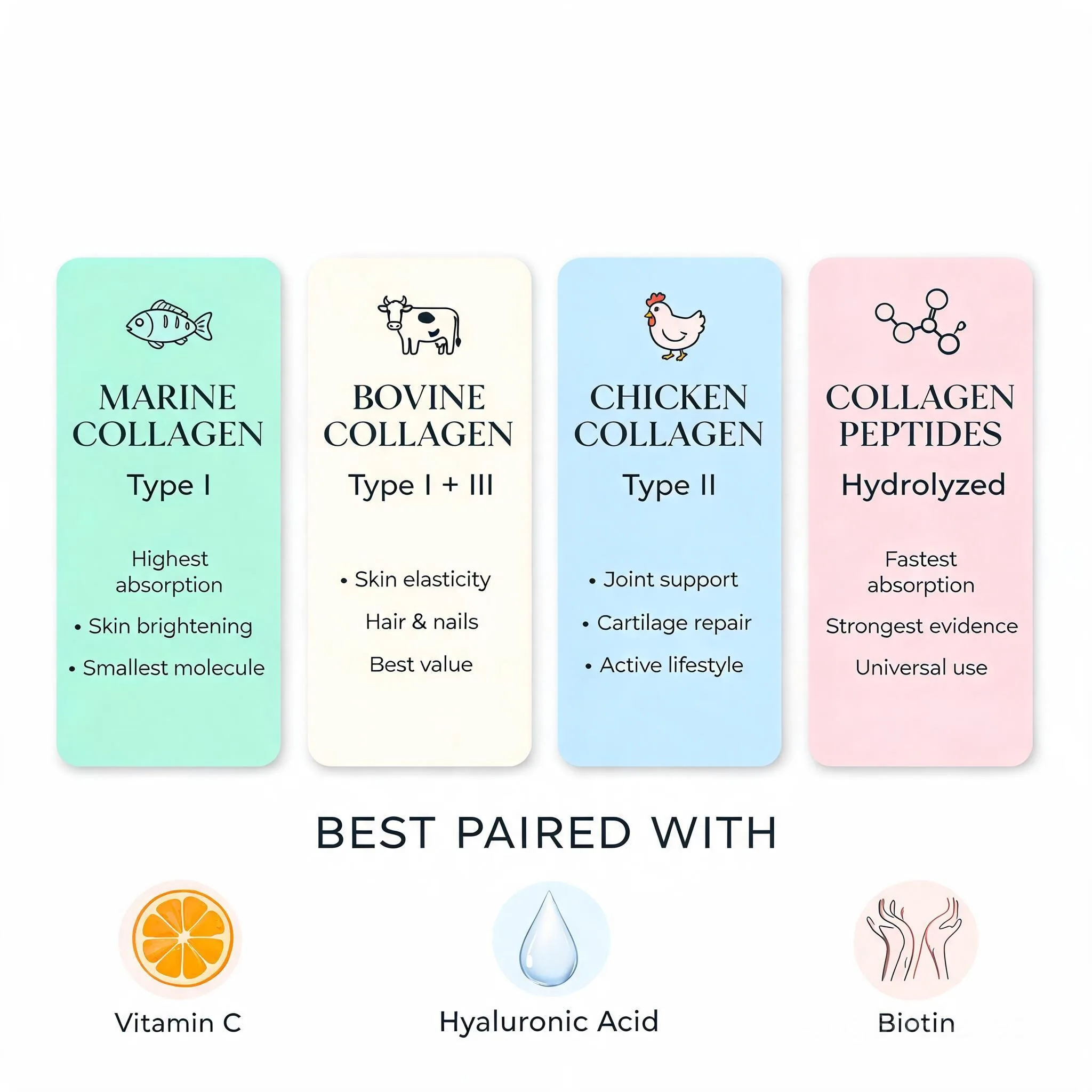
Bovine collagen is the most extensively studied source in clinical literature. It's predominantly Type I (roughly 90%) with about 10% Type III, and after oral ingestion, plasma concentrations typically peak around 30 to 60 minutes. Molecular weight falls in the 2,000 to 5,000 Dalton range for most hydrolyzed forms.
The application range is broad: skin aging, bone support, tendon and connective tissue repair, general wellness. For teams entering the collagen space for the first time, bovine hydrolysate is the lowest-risk starting point — the clinical backing is solid, and consumer recognition is high.
Standard dosing in the literature runs 10 to 20 grams per day, with a minimum of 8 to 12 weeks of consistent use before measurable outcomes become reliable.
Marine Collagen: It's Not Just About Molecular Weight
The default pitch for marine collagen centers on molecular weight — smaller molecules, faster absorption. That's not wrong, but it misses the more important story.
A 2024 study published in Frontiers in Nutrition changed how many formulators should be thinking about this category. The research team compared a GPH-enriched marine collagen peptide against standard hydrolyzed collagen and found that the GPH-enriched version produced a plasma absorption area under the curve (AUC) 54 times higher within the first two hours post-ingestion. Not 54 percent — 54 times.
That number reframes the whole conversation. What drives bioavailability isn't just molecular weight — it's peptide sequence quality. GPH (glycine-proline-hydroxyproline) is the characteristic collagen tripeptide. The higher the GPH content, the higher the bioavailability. When you're evaluating a marine collagen ingredient, the GPH percentage is the number worth asking about — not just the molecular weight claim on the spec sheet.
Marine collagen also tends to be easier on the GI tract, which matters for sensitive consumers. Typical dosing is 2.5 to 10 grams daily over a 6 to 8 week cycle.
Chicken Collagen: The Logic Behind Joint Formulas
Chicken collagen is the primary source of Type II collagen, and it comes in two mechanistically distinct forms: native (undenatured) and hydrolyzed.
Native Type II collagen works through oral immune tolerance — essentially, it interacts with gut-associated immune tissue to train the body to reduce its inflammatory response against joint cartilage. This mechanism is why the effective dose is remarkably low: 40 to 50 milligrams per day. More is not better here. The dosing logic is fundamentally different from amino acid-loading strategies.
Hydrolyzed chicken collagen, by contrast, functions like bovine or marine hydrolysates — providing amino acid building blocks at 5 to 15 grams per day.
For joint health formulas, native Type II (branded ingredients like UC-II fall in this category) is a compelling choice, especially for osteoarthritis or post-exercise joint recovery positioning. It's also the go-to alternative for consumers with fish allergies.
Collagen Peptides: A Category Label, Not a Source
"Collagen peptides" comes up constantly in product development conversations, and it's worth clarifying: it's a processing designation, not a source category. Any hydrolyzed collagen — bovine, marine, chicken — that has been broken down into short-chain peptide fragments is technically a "collagen peptide."
Type I collagen peptides (2,000 to 3,500 Da) are appropriate for skin, bone, and general wellness applications at 5 to 15 grams per day. Type II peptides are more relevant for joint applications, though the native form retains the core competitive advantage in that space.
Getting this distinction clear helps both in supplier negotiations and in consumer-facing communication.
Absorption Ranking: What the Data Actually Shows
Based on the current evidence base, here's how the sources stack up on bioavailability:
- 1. GPH-enriched marine collagen — plasma peak within 10–20 minutes, AUC dramatically higher than all other forms
- 2. Ultra-low molecular weight marine collagen (500–1,000 Da)
- 3. Standard hydrolyzed marine collagen (2,000–3,000 Da)
- 4. Bovine / hydrolyzed chicken collagen peptides — plasma peak at 30–60 minutes
- 5. Native Type II collagen — absorption is not the goal; immune modulation is
That last point matters: native Type II sits at the bottom of an absorption ranking because systemic absorption isn't its mechanism. Ranking it low on bioavailability is like criticizing a probiotic for being "low in nutrients." The framework doesn't apply. Don't let absorption metrics drive decisions about native Type II — efficacy in that category is measured differently.
Vitamin C: Non-Negotiable
This section deserves to stand on its own.
Vitamin C is an essential cofactor for the enzymes that stabilize newly synthesized collagen fibers. Without adequate vitamin C, the structural crosslinks in fresh collagen are weak — the body degrades it faster than it can form. Supplementing collagen without ensuring adequate vitamin C is a formulation gap that undermines your efficacy story.
The practical recommendation: 100 to 200 mg of vitamin C co-administered with collagen. In most finished product formulations, this is already standard. But consumer education often skips it. If your formula doesn't include vitamin C in the blend, the usage instructions should explicitly recommend pairing with a vitamin C supplement or vitamin C-rich foods.
Formulation Strategy: Goal-First Thinking

Beyond vitamin C, several co-ingredients have strong mechanistic rationale depending on application:
- Hyaluronic acid (50–150 mg): Synergistic hydration and elasticity support; strongest evidence when paired with Type I collagen in skin formulas
- Zinc (15–25 mg): Supports collagen crosslinking and modulates matrix metalloproteinase activity (the enzymes that break collagen down)
- Organic silica (10–30 mg): Promotes crosslinking between collagen and elastin; relevant for both skin and bone formulations
- Lysine (1–3 g): Collagen fiber crosslinking precursor; increases tensile strength; commonly used in sports recovery formulas
- Copper (0.9–1.3 mg): Cofactor for a key enzyme in collagen maturation — but watch the zinc-to-copper ratio; these two compete for absorption and shouldn't be stacked casually
Application-based formulation map:
| Target Application | Core Ingredient | Key Co-ingredients |
|---|---|---|
| Skin aging & elasticity | Marine collagen (GPH-enriched preferred) | Vitamin C + hyaluronic acid + zinc (add vitamin E, silica) |
| Joint cartilage & OA | Native Type II (chicken) | Vitamin C + lysine + zinc (add glucosamine, chondroitin) |
| Gut lining & repair | Low molecular weight marine collagen | Vitamin C + glutamine + zinc (add probiotics) |
| Sports recovery | Bovine collagen (Type I/III) | Vitamin C + lysine + silica |
Questions Worth Asking Before You Finalize
The decisions that actually improve a collagen formula rarely come from deeper literature searches. They come from asking sharper questions early:
1. What is this product's single primary claim? Skin, joint, sports recovery, gut health — each maps to a different source and mechanism. A formula trying to cover all four simultaneously usually can't substantiate any of them cleanly. Pick the primary positioning and build around it.
2. Does your target consumer have allergies or dietary restrictions? Fish allergy → chicken or bovine. Vegetarian or vegan → be direct: there is no meaningful plant-based collagen source on the market today. Collagen is an animal protein. Manage consumer expectations clearly rather than hedging with vague language.
3. Can your supplier provide GPH content data? Especially critical for marine collagen ingredients. If a supplier can only give you molecular weight and not peptide sequence composition, push back. GPH percentage is the number that predicts performance — not Da alone.
4. Does your formula include vitamin C, or does your label address it? If neither is true, fix that before launch.
A Note on Individual Variation
Dosage ranges and co-ingredient recommendations here are based on current published research and represent general guidance — not universal prescriptions. Absorption capacity, baseline health status, medication interactions, and specific population needs (pregnancy, older adults, chronic disease management) all affect how a formula performs in the real world. For novel formulations or products targeting vulnerable populations, clinical review with a registered dietitian or qualified formulation consultant is worth the investment.
This article is intended for industry professionals and does not constitute medical advice.
References
- 1. A 2024 study in Frontiers in Nutrition examining the bioavailability of GPH-enriched marine collagen peptides versus standard hydrolyzed collagen, reporting 54-fold AUC superiority at the two-hour mark
- 2. The NIH Office of Dietary Supplements (ODS) review on collagen and skin health evidence
- 3. Research published in Osteoarthritis and Cartilage on the oral immune tolerance mechanism of native Type II collagen
- 4. The International Osteoporosis Foundation (IOF) position paper on collagen peptides and bone metabolism
- 5. NCBI StatPearls review of the biochemical role of vitamin C in collagen synthesis
For Brand Owners
Working on a collagen formula?
Start by asking your ingredient supplier for GPH content data — that number tells you more about performance than anything else on the spec sheet. Albert Max can help pressure-test the source, dose, co-ingredients, and manufacturing format before you commit to production.