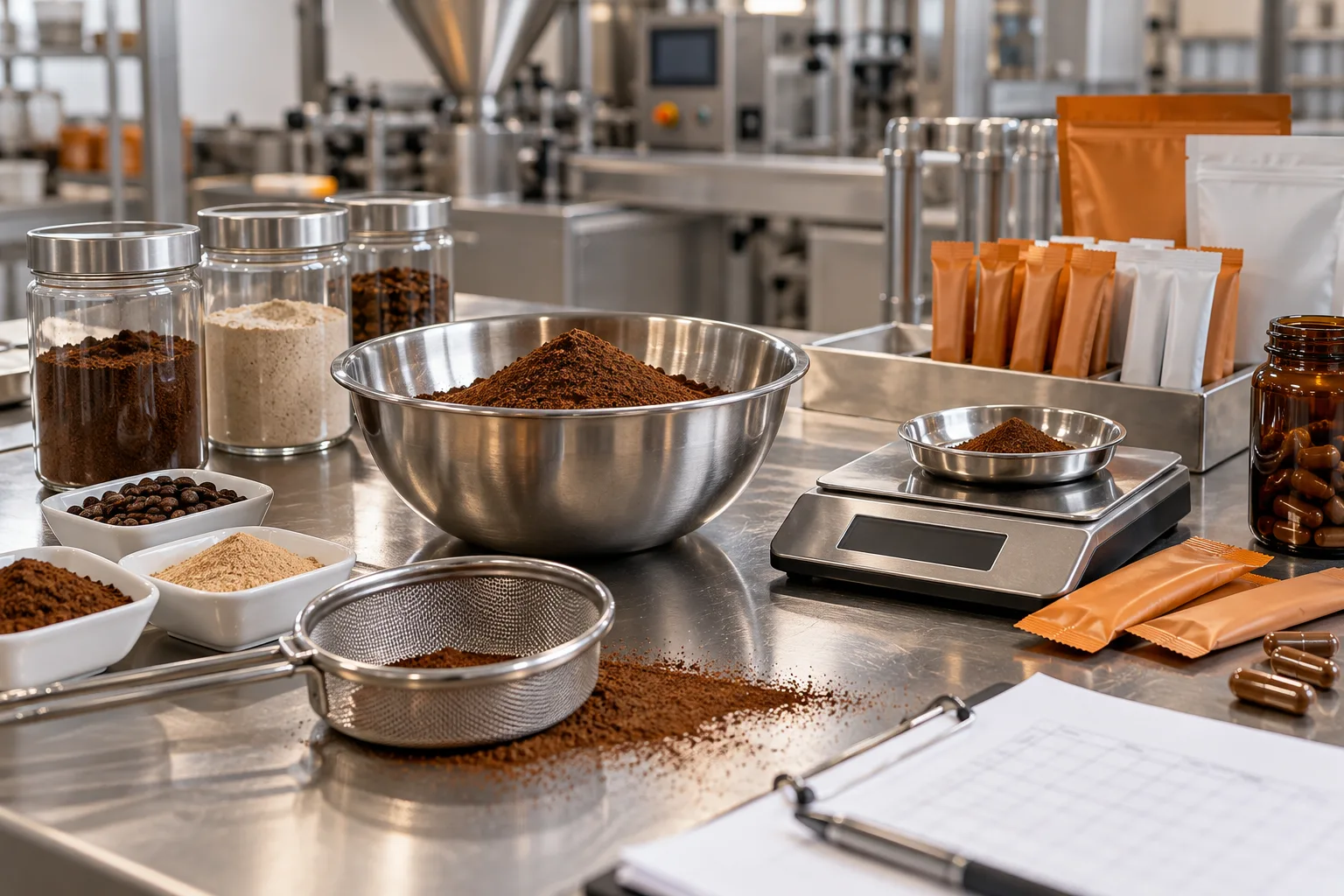
Functional coffee powder sounds easy until the first pilot batch behaves like a real powder. Coffee solids bring bitterness, aroma, color, and caffeine. Protein can add chalkiness and foam. Collagen changes mouthfeel. Prebiotic fiber can thicken or clump. Mushroom and botanical extracts can bring earthy notes, density shifts, and claim-review work.
That is why functional coffee manufacturing should start before the brand story is finished. The formula, serving size, caffeine logic, flavor system, packaging, and cGMP records have to work together if the product is going to survive repeat daily use.
Start with the consumer preparation
The manufacturing plan should begin with a basic question: how will the consumer actually use this product? A scoop into hot coffee behaves differently from a cold iced coffee mix. A single-serve stick pack has different volume and moisture constraints than a tub. A creamer-style powder may need better mouthfeel and dispersion than a capsule companion.
Albert Max reviews preparation method early because it changes the technical work. Hot liquid can expose protein texture. Cold liquid can expose poor instantization. Coffee bitterness can collide with botanicals. A product that looks clean on a formula sheet can still fail in a real mug.
| Control point | What can go wrong | Manufacturing response |
|---|---|---|
| Coffee base | Burnt, bitter, acidic, or inconsistent flavor across lots | Ingredient qualification, sensory review, lot controls, and flavor matching |
| Protein or collagen | Chalkiness, foam, poor dispersion, or too-large serving size | Source selection, particle behavior review, serving-size planning, and mix testing |
| Prebiotic fiber | Clumping, viscosity, gritty mouthfeel, or stick-pack overflow | Hydration checks, density review, flow testing, and packaging fit trials |
| Caffeine and focus ingredients | Unclear stimulant load or risky consumer instructions | Caffeine source mapping, label review, warning logic, and claim discipline |
Flavor masking is harder when coffee is the hero
Coffee can cover some off-notes, but it is not magic. Bitter botanicals can stack on top of coffee bitterness. Protein can flatten aroma. Minerals can add metallic notes. Sweeteners can taste harsh if the roast profile, creamer system, and acidity are not balanced.
For functional coffee, flavor work should happen with the active system in place. A base coffee flavor that tastes good by itself may not survive protein, collagen, mushrooms, fiber, or B vitamins. Our guide to flavor masking for bitter actives covers the same principle: taste is a formulation control, not a last-minute decoration.
Caffeine needs a clear source map
Functional coffee brands should know exactly where caffeine enters the formula: coffee solids, coffee extract, added caffeine, guarana, green tea, yerba mate, or other stimulant ingredients. Each path changes the label review, warning logic, serving directions, and testing plan.
The FDA has warned against pure and highly concentrated caffeine products sold as dietary supplements. A functional coffee powder is a different product type, but the core lesson is still useful: stimulant exposure should be designed, measured, and communicated clearly. Sloppy caffeine math is not a product strategy.
Map caffeine
Identify every caffeine source and define target level, serving use, and warning review.
Build the sensory system
Test coffee, actives, sweetener, creamer notes, and preparation method together.
Pressure-test the powder
Review density, flow, moisture, clumping, fill weight, and package fit.
Lock the records
Align specifications, MMR, BPR, QC release, label claims, and change controls.
Stick packs look simple until the powder has to flow
Functional coffee is a natural fit for single-serve convenience, but stick packs are not forgiving. Protein, collagen, fiber, instant coffee, creamer systems, and botanicals can all affect density, dusting, flow, seal area, moisture sensitivity, and fill-weight consistency.
Albert Max has written about these problems in powder stick pack manufacturing controls. Functional coffee adds another layer because the consumer will judge both the nutrition promise and the coffee experience. A beautiful sachet does not matter if the product clumps in cold liquid or tastes like overworked bitterness.
Claims should match the formula, not the trend deck
Functional coffee can sit near energy, focus, gut health, beauty, active aging, and daily performance. That does not mean every product should claim all of them. Stronger products usually choose a clear lead benefit and keep supporting claims specific, substantiated, and compatible with dietary supplement structure/function rules.
For the market side of this category, see Albert Max's companion article on functional coffee supplement trends in 2026. For adjacent formulation logic, our articles on clear protein powder formulation and prebiotic powder formulation show how ingredient behavior can shape the finished product long before scale-up.
cGMP controls keep the story and batch aligned
Under dietary supplement cGMP requirements, a functional coffee supplement still needs specifications, master manufacturing records, batch production records, quality review, packaging controls, and documentation for identity, purity, strength, composition, and quality. A trendy format does not reduce the documentation burden.
Albert Max connects custom formulation, dosage manufacturing, packaging, and quality systems so the product concept, label direction, and production record stay connected.
Manufacturing takeaway
Do not let coffee make the formula look easier than it is.
Functional coffee powders need sensory discipline, caffeine discipline, format discipline, and cGMP discipline. The earlier those pieces are reviewed together, the cleaner the launch becomes.
References
- U.S. Food & Drug Administration. FDA warns consumers about pure and highly concentrated caffeine.
- U.S. Food & Drug Administration. Guidance for Industry: Highly Concentrated Caffeine in Dietary Supplements.
- eCFR. 21 CFR Part 111 - Current Good Manufacturing Practice for Dietary Supplements.
- U.S. Food & Drug Administration. Small Entity Compliance Guide on Structure/Function Claims.